How to Do Bilateral Stimulation at Home: A Practical Guide
A practical, research-grounded guide to bilateral stimulation as a self-directed wellness practice — what to do, what to avoid, and when to involve a professional.


How to Do Bilateral Stimulation at Home: A Practical Guide
If you’ve read about bilateral stimulation and want to try it yourself, the first thing worth knowing is that the practice splits cleanly into two categories — and they’re not interchangeable.
The first category is self-directed bilateral stimulation as a wellness practice: using rhythmic, alternating left-right input to regulate your nervous system, settle anxious activation, or create a five-minute reset in the middle of a chaotic day. This is what most people are looking for when they search “bilateral stimulation at home.” It’s the version of the practice this guide is written for.
The second category is EMDR therapy — the structured eight-phase clinical protocol used by trained therapists to help people process specific traumatic memories. EMDR uses bilateral stimulation as one of its core ingredients, but the therapy is not the technique alone. It’s the technique held inside a clinical container that includes assessment, preparation, careful memory targeting, integration, and a trained clinician monitoring for things like dissociation. Self-directed bilateral stimulation is not a do-it-yourself version of EMDR therapy, and treating it as one is the single most common mistake people make.
This guide is about category one. If you’ve got significant trauma you’re trying to process, please skip this guide and find a therapist. If you want a practical at-home tool for daily nervous-system regulation, read on.
Three forms that actually work
Bilateral stimulation just means rhythmic sensory input alternating between the left and right sides of the body. There’s no single “correct” form — research has tested visual (eye movements), tactile (alternating taps), and auditory (alternating tones) modalities and found all three produce broadly comparable effects.[1] What matters is the rhythm, the alternation, and the dual attention required to track it while staying present.
Three forms are practical for at-home use:
1. Visual: tracking a moving point. This is the original form Francine Shapiro described in 1989 and the one most associated with EMDR.[2] You follow an object — a moving dot on a screen, your therapist’s finger in clinical practice, even your own thumb held at arm’s length — as it moves smoothly back and forth across your field of vision. The pace is roughly one full pass (left → right → left) every two seconds, though faster and slower paces work too.
2. Tactile: alternating taps. The cleanest way to do this on your own is the “butterfly hug,” a method developed by EMDR therapists Lucina Artigas and Ignacio Jarero in 1998 while working with survivors of Hurricane Pauline in Mexico. It’s now an evidence-based standard practice, and a 2025 fMRI study published in the Iberoamerican Journal of Psychotraumatology and Dissociation found measurable neurobiological effects when the technique was used as part of EMDR protocols.[3] We’ll cover it in detail below.
3. Auditory: alternating tones through headphones. Specially produced audio that alternates a soft tone or sound between the left and right ear channels. This is the least studied of the three but follows the same underlying principle, and apps and audio tracks designed for this exist. (Note: alternating-tone audio is bilateral beats, which is a different thing from binaural beats — those use a frequency mismatch between the ears to produce a perceived third tone. They’re often confused. Bilateral beats are the relevant form here.)
You don’t need all three. Pick whichever modality matches the situation you’re in — auditory works for the train, tactile works in a meeting bathroom, visual works at your desk.
The Butterfly Hug, step by step
Of the three, the butterfly hug is the most accessible because it requires nothing — no app, no audio, no screen. You can do it anywhere. Here’s the full protocol as Artigas and Jarero published it:[3:1]
- Sit upright in a chair, both feet flat on the floor. The position matters less than the upright posture; you’re not trying to lie down or curl up.
- Cross your arms over your chest so each hand rests just below the opposite collarbone. Your middle fingers should land in the soft tissue beneath the clavicle, with the rest of your fingers spread across the upper chest. If you want, hook your thumbs together — some people find it provides a sense of being anchored.
- Soften your eyes — close them, or let them rest with a soft downward focus. The original protocol suggests focusing on the tip of your nose if you want to keep them open, which sounds odd but works to settle the visual system.
- Begin tapping your hands alternately, gently. Left hand taps the right shoulder, then right hand taps the left shoulder, slow and steady. Imagine butterfly wings opening and closing — slow, smooth, rhythmic. The pace is roughly one tap per second per hand, so a full left-right cycle every two seconds.
- Notice your breath. Let it move naturally. Don’t try to force a particular rhythm. Just notice the rise and fall.
- Continue for 30 seconds to a few minutes, depending on what you need. The original protocol suggests stopping when you feel “calmer and more grounded in the present moment than when you started.” That’s the marker. There’s no fixed duration.
A few practical notes: the taps should feel gentle, not vigorous. If you’re hitting yourself hard enough to leave marks, you’re doing it wrong. The technique is about rhythm and bilateral input, not stimulation intensity. And if you find your mind racing, that’s normal — you don’t have to clear it. Just notice it racing and let the tapping rhythm anchor you.
The butterfly hug is the most flexible of the three forms because you can do it during a panic spike in a public bathroom, on the floor of your office between meetings, lying in bed when sleep won’t come. It travels well.
What about screen-based bilateral stimulation?
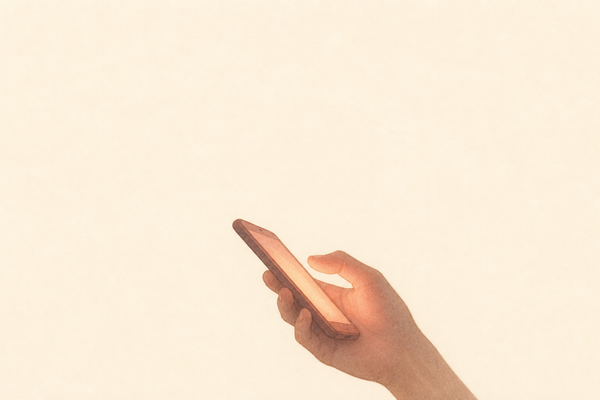
This is the form RealignMind provides — and the form most easily mass-produced as a self-directed tool, since it works on any laptop or phone. A point moves rhythmically across the screen. Sometimes paired with audio that alternates between channels. You watch and follow.
The advantage of the screen-based form is that the pacing is controlled — you don’t have to maintain rhythm yourself, the way you do with the butterfly hug. For people whose attention scatters under stress, this matters. The technique works because of the bilateral rhythm; if your “rhythm” wanders because your brain is too activated to keep time, the technique loses some of its effect. A consistent visual pace removes that variable.
The disadvantage is that you need a screen, which means it’s less accessible in moments when you’re not at one (in line at the grocery store, on a hike, during a tense conversation). It’s a “sit-down practice” rather than an anywhere-practice.
The honest answer is that you probably want both. Screen-based for deliberate practice — the morning reset, the lunchtime decompress, the post-difficult-meeting wind-down — and the butterfly hug for the anywhere moments.
When to use it (and when not to)
Good times to use bilateral stimulation:
- Your nervous system is activated and you want to settle it. Heart racing, mind looping, body tense.
- Between high-intensity transitions — after a difficult conversation, before a stressful call, end-of-day decompression before going home.
- As part of a daily reset practice, the way some people use a five-minute meditation or a short walk.
- When you notice yourself spinning in low-grade anxiety and you want to interrupt the loop without “trying harder to relax.”
Times to be cautious:
- If you’re working through significant trauma. This isn’t a hard rule against using bilateral stimulation entirely — many people find it useful as a daily regulating practice while they’re also in trauma therapy — but it’s a hard rule against using it as a self-directed substitute for therapy. If you’re processing memories that overwhelm you, you need a clinician, not an app.
- If you experience dissociation (feeling unreal, disconnected from your body, time-loss). Bilateral stimulation can intensify dissociation in some people, and self-directed use without clinical guidance is contraindicated.
- If you have active flashbacks or intrusive trauma memories. Same caution. The technique can activate processing that’s hard to manage alone.
- If you’re in acute crisis. Bilateral stimulation isn’t a crisis intervention. If you’re in immediate distress, the right call is a crisis line or trusted clinician, not an app.
For the broad category of “I’m a generally functional adult dealing with stress, anxiety, scatter, and overwhelm” — which is most readers of most posts about this — at-home bilateral stimulation is a tool worth having.
A simple protocol you can use today
If you want a starting point that doesn’t require any equipment, try this:
- Sit somewhere quiet for five minutes.
- Notice how you feel — physically, emotionally. Don’t analyze. Just notice.
- Do the butterfly hug for two minutes. Slow, gentle, rhythmic.
- Pause. Notice again. What changed? What didn’t?
- If you want, do another two minutes. Stop when you feel done.
That’s it. There’s no eight-phase protocol you need to memorize. The technique is genuinely simple. What it isn’t is a quick fix, or a substitute for the other things — sleep, movement, social connection, professional help when you need it — that your nervous system also needs.
It’s a tool. A useful one. Worth having in the kit.
If you want a screen-based version
RealignMind is what we built for the screen-based form. Visual and auditory bilateral stimulation, customizable pacing, designed for the five-minute window when you want a reset and don’t have anything else handy. Free demo, no signup required.
Try the bilateral stimulation demo →
If the butterfly hug works for you and that’s all you ever need, you don’t need the app. The technique is the technique. We just made the screen-based form easier to access.
RealignMind is a wellness tool, not a medical treatment. It is not a substitute for therapy and cannot diagnose, treat, cure, or prevent any condition. If you’re working with trauma, dissociation, or significant mental health symptoms, please consult a licensed clinician. In the U.S., you can reach the 988 Suicide and Crisis Lifeline by calling or texting 988.
Sources
- de Jongh, A., et al. (2024). State of the science: Eye movement desensitization and reprocessing (EMDR) therapy. Journal of Traumatic Stress. https://onlinelibrary.wiley.com/doi/10.1002/jts.23012 ↩︎
- Shapiro, F. (1989). Efficacy of the eye movement desensitization procedure in the treatment of traumatic memories. Journal of Traumatic Stress. Foundational EMDR paper. Modern overview at the EMDR International Association: https://www.emdria.org/about-emdr-therapy/ ↩︎
- Jarero, I., & Artigas, L. (2021). The EMDR Therapy butterfly hug method for self-administered bilateral stimulation. Iberoamerican Journal of Psychotraumatology and Dissociation. Available via the EMDR International Association: https://www.emdria.org/resource/the-emdr-therapy-butterfly-hug-method-for-self-administered-bilateral-stimulation-iberoamerican-journal-of-psychotraumatology-and-dissociation/ — 2025 fMRI validation reported by the Institute of Psychotraumatology: https://iptrauma.org/new-research-validates-the-butterfly-hug-as-a-evidence-based-trauma-tool/ ↩︎ ↩︎